Going through the unfinished drafts of blog posts, I discovered this one from the early days of the blog. In celebration of our twelfth year, here is our 1,232nd blog post - a litany of reference questions and an observation about one of the hardest types of question.
Do you have a map of the travels of St. Paul? Where can I find an annual report of a company? Do you have the tax form for filing returns late? Who invented Mrs. (Santa) Claus? Who is the CEO of Overlook Hospital and what is his phone number? Can you get me the Texaco Star Theater featuring Ed Wynn on cassette? What were the reviews of the play "Diary of Anne Frank" when it first appeared in Israel and Germany in 1955 and 1956? Does Columbia Middle School have a time capsule and where is it? How can I get rid of the smell of a dead deer from the road in front of my house? Can you get me the Fugitive Slave Cases, 1850 - 1860 from the United States District Courts in Pennsylvania? Where did the glaciers stop in Berkeley Heights? How can I find missing classmates for my 60th high school reunion? I need to see the Williamsburg paint colors. Can you get me Joan Hamburg's recipe for ginger cookies; she mentioned them on her radio show. How can I learn how to read an annual report? I read a book from this library that I really liked a few years ago, but I don't remember the author or title, can you find it? I need the N.J. law about unlawful dumping of trash. Do you have a form for a living will? What newspapers do they have in Omaha, Nebraska and what are the phone numbers? What should I read next? Do you have the book that gives the value of cars? Who is my N.J. state representative? Can you find an obituary in the Star Ledger - I don't know the person's name or when he died. How should I prune grape vines? How do you distill water?
We get questions like this every day in the Reference Department, by phone, by email and in person.
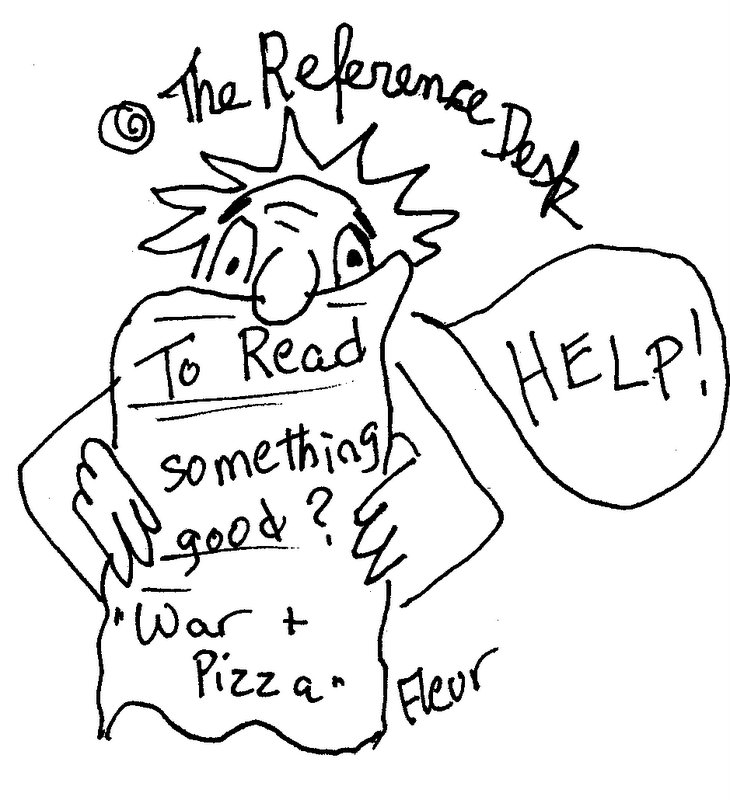
Which one of the above is the most difficult question? I think it is, "what should I read next?" What people like to read is completely subjective and often hard to describe. The so-called "readers' advisory" question is definitely the trickiest one to answer successfully.
So answering questions that can be answered with a fact is far easier than answering a question that requires a subjective judgement based on the taste of the person who asks the question. But if you do ask your local public librarian what to read next, the librarian will try very hard to figure out what kind of reader you are, what reading mood you are in, and will try to steer you towards something enjoyable. Forget 'book guilt,' librarians just want people to enjoy reading.
Showing posts with label readers advisory. Show all posts
Thursday, October 5, 2017
Tuesday, September 26, 2017
Marian the Librarian Returns
This blog post was first published on October 21, 2009. It features our favorite, if slightly prim, librarian, Marian. Here at the Reference Desk, we rarely have this kind of biblio emergency, but you never know...
Is There a Librarian in the House?
People don't become librarians for the fame, fortune or excitement, but there's a little Walter Mitty in all of us...
Marian the Librarian is flying to a librarian convention, nodding off in her middle seat, which she has thoughtfully not tipped back to avoid annoying the passengers behind her, and trying not to snore or drool or touch either arm rest lest she infringe on her seatmates' personal space, she hears the P.A. announcement,
"Is there a librarian on board? we have a slight emergency in Business Class requiring immediate biblio assistance."
Marian jerks awake instantly, eye's pop open, she nods apologetically to the passenger in the aisle seat and indicates she needs to get by. Grabbing her bookbag from under the seat, she hurries up the aisle to the Flight Attendant and whispers,
"I'm a librarian. How can I help?"
"There's a passenger in extreme distress, hyperventilating over a book he's reading and looking pale and clammy, almost like he's in shock," the FA explains as she leads Marion through Business Class to a seat where, indeed, a male passenger, middle-aged, well-dressed, is breathing unevenly with his hands gripping the latest Dan Brown best seller tightly.
"Oh dear, that's the third case I've seen this week. Deadly Prose Syndrome with Implausable Plot Complications. We have to act quickly."
Marian carefully pries the stricken man's fingers from the Lost Symbol and places it in a sick bag for disposal.
"I'm afraid the only treatment for this patron, er patient, is an immediate infusion of The Classics or failing that, any book with sufficient character development, three-syllable words and dependent clauses to act as an antidote. I think this will work."
Marian riffles through her black bag and pulls out Hawthorne's The Scarlet Letter, and places it gently in the man's hands.
"That should do it. I may have to read it aloud to him at first but then his ability to read on his own should kick in and he'll be right as rain."
Marian the Librarian is flying to a librarian convention, nodding off in her middle seat, which she has thoughtfully not tipped back to avoid annoying the passengers behind her, and trying not to snore or drool or touch either arm rest lest she infringe on her seatmates' personal space, she hears the P.A. announcement,
"Is there a librarian on board? we have a slight emergency in Business Class requiring immediate biblio assistance."
Marian jerks awake instantly, eye's pop open, she nods apologetically to the passenger in the aisle seat and indicates she needs to get by. Grabbing her bookbag from under the seat, she hurries up the aisle to the Flight Attendant and whispers,
"I'm a librarian. How can I help?"
"There's a passenger in extreme distress, hyperventilating over a book he's reading and looking pale and clammy, almost like he's in shock," the FA explains as she leads Marion through Business Class to a seat where, indeed, a male passenger, middle-aged, well-dressed, is breathing unevenly with his hands gripping the latest Dan Brown best seller tightly.
"Oh dear, that's the third case I've seen this week. Deadly Prose Syndrome with Implausable Plot Complications. We have to act quickly."
Marian carefully pries the stricken man's fingers from the Lost Symbol and places it in a sick bag for disposal.
"I'm afraid the only treatment for this patron, er patient, is an immediate infusion of The Classics or failing that, any book with sufficient character development, three-syllable words and dependent clauses to act as an antidote. I think this will work."
Marian riffles through her black bag and pulls out Hawthorne's The Scarlet Letter, and places it gently in the man's hands.
"That should do it. I may have to read it aloud to him at first but then his ability to read on his own should kick in and he'll be right as rain."
Tuesday, September 20, 2016
Coming of Age Books
Coming-of-Age
Try asking people for examples of coming-of-age novels. Most readers agree that these stories follow
the changes experienced as a character matures from youth or adolescence to
adulthood. Perhaps adulthood should not
be measured in years, but in a character’s evolving and expanding view of the
world. Maybe it is when the character
realizes that he/she is not the center of the world, but a participant. Scarlett O’Hara took so long to reach that
point that I was surprised to find Gone
With the Wind on one
coming-of-age list. I think readers
could argue if Harper Lee’s To Kill a
Mockingbird should be replaced on coming-of-age lists by Harper Lee’s Go Set a Watchman.
Older lists of coming-of-age novels contain books such as Anne of Avonlea, David Copperfield, and The
Secret Garden. Slightly newer lists
will contain Catcher in the Rye, A Separate Peace, A Tree Grows in Brooklyn,
Lord of the Flies, and S.E. Hinton’s The Outsiders. An even newer list will have Nick & Norah’s Playlist, Secret Life of Bees,
Kite Runner, Perks of being a Wallflower, Eleanor & Park, About a Boy and
Fangirl. John Green has dominated
the market with Looking for Alaska, An
Abundance of Katherines, and Fault in Our Stars. J.K Rowling gave us the Harry Potter series
and Suzanne Collins created Katnis Everdeen and the Hunger Games trilogy. We
have watched all of these characters mature whether we like or dislike the
adults they became.
Although I have read and enjoyed many of the titles
mentioned above, my coming-of-age list would include Girl With a Pearl Earring by Tracy Chevalier, Girl’s Guide to Hunting and Fishing by Melissa Banks, Cold Sassy Tree by Olive Ann Burns, Red Sky at Morning by Richard Bradford and
Montana 1948 by Larry Watson. It is an eclectic mix, spanning from 17th
century Holland to the mid-century United States. Whatever your definition of coming-of-age novels may be, these books can be enjoyed long after adolescence.
-S. Bakos
Related lists:
Coming of Age books on Goodreads
11 Coming-of-Age Books from the Huffington Post
Bildungsroman definition
Great Coming of Age Novels on Pinterest
-S. Bakos
Related lists:
Coming of Age books on Goodreads
11 Coming-of-Age Books from the Huffington Post
![]() |
| Flavia Comes of Age |
Great Coming of Age Novels on Pinterest
![]() |
| Harry Potter Comes of Age |
Thursday, August 11, 2016
Dinner with Edward by Isabel Vincent
So Many Books, So Little Time
Working at the library we are obviously surrounded by books. With many returned books come book suggestions. With book suggestions come more book suggestions and sometimes even movie suggestions. Many times patrons tell us,
“You have to read this book. It’s the best I’ve ever read!”
If I have read the book and enjoyed it, a lively discussion ensues. If I read the book and did not care for it, I invoke my two favorite comments:
1.) It’s well written :) Hopefully his/her next novel’s material will be more to my liking.
2.) I wanted to like the book but…
Just ask my book club friends they will tell you I use the first comment frequently during our monthly discussions.
If I have not read the book and it sounds appealing, I place it on my Goodreads app. Currently I have 172 books on my ToRead list within the app. I just need 172 weeks to read them all! So really I shouldn’t be looking for additional books to read, but I just can’t help myself.
Sometimes a book is quietly returned without any fanfare. I wonder if the book was finished, liked, disliked…
Last Thursday, Dinner with Edward: the Story of an Unexpected Friendship by Isabel Vincent (2016) was returned. As I went to reshelve this new nonfiction book, I read the back cover: a memoir of food, NYC, and friendship - what could be better? I had to give it a try. Ignoring my reading lists, I took the book home. During the course of my busy weekend, I read the book with the not-too-long and not-too-short chapters and fell in love with the book and with Edward. Each chapter begins with a menu for their weekly dinner that will be consumed when Isabel visits her friend Edward on Roosevelt Island. Each menu sounds wonderful. My only wish would be that the author had included recipes as so many of my favorite cozy mystery writers do. A cocktail and “catching up” discussion are always part of each chapter as well as some background allowing us to understand Edward and Isabel's current discussion.
Although fiction, A Man Called Ove by Fredrik Backman and Major Pettigrew’s Last Stand by Helen Simonson remind me of this sweet story. When asked for my current favorite, I will suggest Dinner with Edward.
~ Ann-Marie Sieczka
August 10, 2016
Working at the library we are obviously surrounded by books. With many returned books come book suggestions. With book suggestions come more book suggestions and sometimes even movie suggestions. Many times patrons tell us,
“You have to read this book. It’s the best I’ve ever read!”
If I have read the book and enjoyed it, a lively discussion ensues. If I read the book and did not care for it, I invoke my two favorite comments:
1.) It’s well written :) Hopefully his/her next novel’s material will be more to my liking.
2.) I wanted to like the book but…
Just ask my book club friends they will tell you I use the first comment frequently during our monthly discussions.
If I have not read the book and it sounds appealing, I place it on my Goodreads app. Currently I have 172 books on my ToRead list within the app. I just need 172 weeks to read them all! So really I shouldn’t be looking for additional books to read, but I just can’t help myself.
Sometimes a book is quietly returned without any fanfare. I wonder if the book was finished, liked, disliked…
Last Thursday, Dinner with Edward: the Story of an Unexpected Friendship by Isabel Vincent (2016) was returned. As I went to reshelve this new nonfiction book, I read the back cover: a memoir of food, NYC, and friendship - what could be better? I had to give it a try. Ignoring my reading lists, I took the book home. During the course of my busy weekend, I read the book with the not-too-long and not-too-short chapters and fell in love with the book and with Edward. Each chapter begins with a menu for their weekly dinner that will be consumed when Isabel visits her friend Edward on Roosevelt Island. Each menu sounds wonderful. My only wish would be that the author had included recipes as so many of my favorite cozy mystery writers do. A cocktail and “catching up” discussion are always part of each chapter as well as some background allowing us to understand Edward and Isabel's current discussion.
Although fiction, A Man Called Ove by Fredrik Backman and Major Pettigrew’s Last Stand by Helen Simonson remind me of this sweet story. When asked for my current favorite, I will suggest Dinner with Edward.
~ Ann-Marie Sieczka
August 10, 2016
Labels
biography,
book_review,
food,
memoirs,
New York City,
old age,
readalikes,
readers advisory
Tuesday, June 28, 2016
What to Read While Sick
This winter, yours truly disappeared from the Reference Desk for several months after contracting a rare condition called Guillain Barre Syndrome. On the day that I headed to the emergency department of the local hospital, I threw the book I was reading into my purse:The Road to Little Dribbling, adventures of an American in Britain by Bill Bryson. Mr. Bryson is one of my favorite authors, a very funny
travel writer and humorist, so I was not going anywhere without his
book. But it turned out to be too big and too heavy to pick up and hold as my hands were growing weaker quickly. As
strength gradually returned to my hands, I finally did finish the book. It was
great. It took my tired mind a month to get through it, but finish it, I
did. Then I re-read Mr. Bryson's travel books in reverse
chronological order after I got home by raiding my daughter's bookcases.
I was looking forward to the bit about how hard it is to understand
Glasgow cabdrivers and it did not disappoint. My daughter and I used to
read aloud this bit and other Bryson gems to each other, but could never
get through them without breaking up. He is that kind of funny. I guess
the greater lesson might be: don't take heavy books to the ED, you
might be too sick to read/hold them. On the other hand, humor is the
best medicine. So take the book anyway.
What else did I read while sick? Well, first of all, when a librarian gets sick, the library staff naturally starts thinking about what that sick librarian might like to read and dispatches a staff member to the hospital with a book bag full of books. Using their best readers' advisory skills, my colleagues felt that light, humorous books would seem to be the order of the day. The books had to be lightweight in both senses of the word - easy to hold and easy to read. So all this got me to thinking about how do we accommodate our reading habits to an illness? I started in the usual way by browsing through magazines that were mostly pictures and celebrity gossip that my daughter bought in the hospital gift shop. Then I graduated to my favorite mystery author M.C. Beaton whose books my coworker had brought in the BHPL bookbag. Perfect: escaping to the Highlands of Scotland to solve murders was just the ticket. I reread Death of a Nurse and Death of a Valentine
After returning home, I reread some of my favorite children's books:
The Secret Garden by Frances Hodgson Burnett was even better than I remembered and was about the curative powers of hanging out in nature, breathing in fresh air and, of course, gardening. How apropos! I could not garden without falling over, but I could read about it.
Beyond the Paw Paw Trees and The Silver Nutmeg by Palmer Brown were so enchanting and inventive and slyly humorous - good for early elementary age or a sick person wanting to escape.
The first two Harry Potter books by J.K. Rowling: Harry Potter and the Sorcerer's Stone and Harry Potter and the Chamber of Secrets were better the second time around.
Little Town on the Prairie by Laura Ingalls Wilder was not one of her best, but I think the idea of rereading the Little House series was good. I still like The Long Winter and Little House in the Big Woods best.
I also read from a pile of 'emergency' books that I buy from the library sale racks, mostly mysteries. Owning books has the advantage of no due dates to worry about. Admit it- you have a pile of emergency books, right? I read the second and third Smiley books by John Le Carre: A Murder of Quality and Tinker, Tailor, Soldier, Spy (and then watched the movie which I borrowed from the library.) Those were the first Smiley books I ever read and obviously I now have to track down the first one, Call for the Dead, and read that because these old spy thrillers were great.
As noted in the post from earlier this month, hoping to get some perspective on my situation, I read two books about how people cope with severe illnesses: Left Neglected and A Lucky Life Interrupted. On my 'To Read' list is The Anatomy of Hope: how people prevail in the face of illness by Jerome Groopman which Tom Brokaw, author of A Lucky Life Interrupted recommended.
I did not read or listen to books on my iPad, but for some patients, listening to audiobooks is a good
option, especially if there are vision issues or trouble holding books or possibly while undergoing infusions which can take quite a while. Another option is to use Hoopla on a tablet. The library offers movies, music, audio- and e-books and TV shows through Hoopla. Patrons can put the app on their tablet and watch/listen/read up to 8 titles per month for free. Flipster and Zinio offer free browseable magazines to library card holders which look beautiful using the app on a tablet. Take a look at our All Things E page for these and other downloadables.
What to read while sick? Whatever you want is the answer. This was one time in my life when I did not feel I really should read some difficult, 'improving' tome. Thanks to all the authors who helped me get through this and thanks to the BHPL staff for those book bags full of light mysteries and quirky novels. Thanks to so many patrons, family and friends for visiting, texting, emailing, calling, sending cards and flowers. I am back at the Reference Desk, see my cartoon below, awaiting your questions.
Further Reading:
Joseph Heller, author of Catch 22, may be the most famous author to get Guillain Barre Syndrome and he wrote a book about the experience, No Laughing Matter. I just started it and it is fantastically written. I may put Catch 22 on my reread list now.
Guillain Barre Syndrome Fact Sheet from the National Institute of Neurological Disorders and Stroke
The library's All Things E page has links to our downloadable resources for Berkeley Heights Public Library card holders.
Before falling ill, my only knowledge of certain medical specialties was from reading funny medical blogs:
My favorite neurologist, besides my own, writes the very funny Dr. Grumpy is in the House
My favorite physiatrist, doctors who treat patients needing physical therapy is the blogger Dr. Fizzy who writes The Cartoon Guide to Becoming a Doctor
No, really, what is a physiatrist? Read this AAPM&R

What else did I read while sick? Well, first of all, when a librarian gets sick, the library staff naturally starts thinking about what that sick librarian might like to read and dispatches a staff member to the hospital with a book bag full of books. Using their best readers' advisory skills, my colleagues felt that light, humorous books would seem to be the order of the day. The books had to be lightweight in both senses of the word - easy to hold and easy to read. So all this got me to thinking about how do we accommodate our reading habits to an illness? I started in the usual way by browsing through magazines that were mostly pictures and celebrity gossip that my daughter bought in the hospital gift shop. Then I graduated to my favorite mystery author M.C. Beaton whose books my coworker had brought in the BHPL bookbag. Perfect: escaping to the Highlands of Scotland to solve murders was just the ticket. I reread Death of a Nurse and Death of a Valentine
After returning home, I reread some of my favorite children's books:
The Secret Garden by Frances Hodgson Burnett was even better than I remembered and was about the curative powers of hanging out in nature, breathing in fresh air and, of course, gardening. How apropos! I could not garden without falling over, but I could read about it.
Beyond the Paw Paw Trees and The Silver Nutmeg by Palmer Brown were so enchanting and inventive and slyly humorous - good for early elementary age or a sick person wanting to escape.
The first two Harry Potter books by J.K. Rowling: Harry Potter and the Sorcerer's Stone and Harry Potter and the Chamber of Secrets were better the second time around.
Little Town on the Prairie by Laura Ingalls Wilder was not one of her best, but I think the idea of rereading the Little House series was good. I still like The Long Winter and Little House in the Big Woods best.
I also read from a pile of 'emergency' books that I buy from the library sale racks, mostly mysteries. Owning books has the advantage of no due dates to worry about. Admit it- you have a pile of emergency books, right? I read the second and third Smiley books by John Le Carre: A Murder of Quality and Tinker, Tailor, Soldier, Spy (and then watched the movie which I borrowed from the library.) Those were the first Smiley books I ever read and obviously I now have to track down the first one, Call for the Dead, and read that because these old spy thrillers were great.
As noted in the post from earlier this month, hoping to get some perspective on my situation, I read two books about how people cope with severe illnesses: Left Neglected and A Lucky Life Interrupted. On my 'To Read' list is The Anatomy of Hope: how people prevail in the face of illness by Jerome Groopman which Tom Brokaw, author of A Lucky Life Interrupted recommended.
I did not read or listen to books on my iPad, but for some patients, listening to audiobooks is a good
option, especially if there are vision issues or trouble holding books or possibly while undergoing infusions which can take quite a while. Another option is to use Hoopla on a tablet. The library offers movies, music, audio- and e-books and TV shows through Hoopla. Patrons can put the app on their tablet and watch/listen/read up to 8 titles per month for free. Flipster and Zinio offer free browseable magazines to library card holders which look beautiful using the app on a tablet. Take a look at our All Things E page for these and other downloadables.
What to read while sick? Whatever you want is the answer. This was one time in my life when I did not feel I really should read some difficult, 'improving' tome. Thanks to all the authors who helped me get through this and thanks to the BHPL staff for those book bags full of light mysteries and quirky novels. Thanks to so many patrons, family and friends for visiting, texting, emailing, calling, sending cards and flowers. I am back at the Reference Desk, see my cartoon below, awaiting your questions.
Further Reading:
Joseph Heller, author of Catch 22, may be the most famous author to get Guillain Barre Syndrome and he wrote a book about the experience, No Laughing Matter. I just started it and it is fantastically written. I may put Catch 22 on my reread list now.
Guillain Barre Syndrome Fact Sheet from the National Institute of Neurological Disorders and Stroke
The library's All Things E page has links to our downloadable resources for Berkeley Heights Public Library card holders.
Before falling ill, my only knowledge of certain medical specialties was from reading funny medical blogs:
My favorite neurologist, besides my own, writes the very funny Dr. Grumpy is in the House
My favorite physiatrist, doctors who treat patients needing physical therapy is the blogger Dr. Fizzy who writes The Cartoon Guide to Becoming a Doctor
No, really, what is a physiatrist? Read this AAPM&R
Tuesday, December 2, 2014
The Time of Year for Best Book List Roundups
While looking through the library blog, I came across this end of year post from six years ago. It made me realize that those end of year look-backs are coming to tell us what happened in 2014. What happened to whom and where in the world it happened. For librarians, it's all about what we read and what we can recommend to our readers. So before I get to 2014, take a look at what we were reading not that long ago. If you missed these books, they will no doubt be waiting on the shelves for you to check out. (Note: some of the links from 2008 no longer work - apologies.)
Best Books Lists 2008 (first posted on 12/26/2008)
Some library patrons print out best books lists and carry them in their wallets all year, working their way systematically through them. Others produce rumpled scraps of paper with faded or illegibly scribbled titles of books recommended by friends, or heard about on the radio or television. Some people rely on their memory and others just browse the shelves when they get to the library. Some people put themselves on reserve for most bestsellers and others never read bestsellers. Some swear by Oprah picks and others find her taste very depressing.
Fortunately enough books are published each year so that there should be something for everyone. The trick is to figure out what it is. As I was browsing through the New Fiction shelves on Tuesday for myself in anticipation of two days off and optimistically thinking there would be time to read, a patron asked for a recommendation. Since I was stumped myself about what to read next, we looked together. My Director and I recommended the Inn at Lake Devine by one of my favorite authors, Laura Lipman and Kaaterskill Falls by Allegra Goodman because the patron seemed to like character-driven, psychological fiction like Jodi Picoult's and Sara Gruen's. I took home Bailey White's holiday stories as told on NPR, Nothing with Strings which was terrific, and Agatha Christie's The ABC Murders as the latest evidence of my 2008 addiction to the Grande Dame of Mysteries.
Take a look at these end of year lists to find what you plan to read in 2009 or come ask at the Reference Desk and we'll see if we can come up with a list made just for you.
NPR, the Complete Holiday Book Recommendations 2008
Amazon's Top 100 Editors Picks and the Top 100 Customer Favorites
Publishers Weekly Best Books of the Year
Louisa Ermelino writes in PW, "There were the authors we expected to deliver, and they did: Louise Erdrich with The Plague of Doves, Richard Price with Lush Life, Jhumpa Lahiri with Unaccustomed Earth, Lydia Millet with How the Dead Dream. A breakthrough surprise about cricket, Netherland by Joseph O'Neill, delighted us, while Tim Winton's Breath took ours away. We listened to our elders in How to Live: A Search for Wisdom from Old People; thought about our planet with The Soul of the Rhino; examined our history in The Hemingses of Monticello and Abraham Lincoln: A Life; and, thanks to Shane Claiborne and Chris Haw, we even considered Jesus for President."
The PW Fiction list starts with Kate Atkinson's When Will There Be Good News? the third novel featuring PI Jackson Brodie which I just started and expect to be as good as the first two.
Library Journal's Best Books 2008
The New York Times 10 Best Books 2008
USA Today's list of 10 Books We Loved Reading in 2008 probably coincides most closely with my own tastes because it includes Olive Kitteridge by Elizabeth Strout and The Guernsey Literary and Potato Peel Pie Society by Mary Ann Shaffer and Annie Barrows which I enjoyed and which both appear on several other lists.
Sure Bets for Readers
What to Read: Sure Bets (originally posted March 27, 2013)
or how does the librarian know what her patrons want to read next?
'titles and sometimes authors that appeal to a wide range of readers, that fly off displays, and that we turn to when our minds go blank and we can't think of anything to suggest to a waiting reader. These aren't current best-sellers but, rather, older titles we treasure.'
However you define it, every reference librarian likes to have certain books to recommend for each type of reader that will be available on the shelf. That's why bestsellers don't fit into this category very well. If a patron NEEDS a book to read RIGHT NOW, recommending a book with a weeks-long waiting list is probably not a helpful suggestion.
Of the books and authors Ms. Saricks recommends, I agree that for fun non-fiction, Mary Roach and Bill Bryson might work for readers who like science (Roach's 'Packing for Mars' is very funny and informative) and who like just plain laugh-out-loud writing (Bryson's 'A Walk in the Woods' has been very well-received by many patrons I have recommended it to.)
Here are some 'sure bets' I have recommended and heard back from readers who enjoyed them:
For readers who want an action/adventure type of mystery, Stuard Woods' Florida-based mysteries deliver a good page-turning experience with a tough-guy edge and a little sex but not too much gore.
For readers who like dark mysteries, try Michael Connelly's Harry Bosch police procedurals set in Los Angeles. Readers who liked the TV series 'The Wire' would be a good fit for this author.
For readers who want cozy, reassuring, character-based novels, our Library Director has had success recommending Mary Ann Shaffer's 'The Guernsey Literary and Potato Peel pie Society'. Unfortunately the author died before the book was published so this is a stand-alone title. But if readers like this historical cozy, they might enjoy Adriana Trigiani's 'Big Stone Gap' series based in West Virginia.
Trigiani falls almost in the 'chic lit' category but without the shopping aspect. For more good writing in the chic lit genre, try anything by Jennifer Weiner.
Some readers are WWII fans, for them recommend 'Unbroken, a World War II Story of Survival, Resilience and Redemption' by Lauren Hillenbrand.
My favorite genre is cozy mystery, so if I find a fellow cozy fan who has not yet discovered Alexander McCall Smith's 'Number One Ladies Detective Agency' series, I can feel confident that reader is going to have a lot of good reading ahead of her.
Putting the right book in the right hands at the right time that suits the reader's mood just that that moment is a great feeling. What are some of your sure bets?
Subscribe to:
Posts (Atom)